Electromagnetics, Microwave Circuit, and Antenna Design for Communications Engineering, Second Edition

Appendix D: Fourier Series and Fourier Transform

D.1 The Fourier Series

Periodic signals may be expanded into a Fourier series [1 3]. A signal for which

(D.1)

is valid is called a periodic signal with the period T 0. The fundamental frequency f 0 is given by f 0 = 1/ T 0 and the corresponding angular frequency is ? 0 = 2 ?f 0. A signal

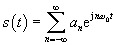
(D.2)

which is a superposition of harmonic signals at the fundamental frequency f and the harmonics nf is periodic with T 0. The series according to (D.2) is called a Fourier series. The expansion coefficients a n are the complex amplitudes at the frequencies n ? 0. The signal s( t) is real if the condition is fulfilled. For real signals s( t) it follows from (D.2) and that

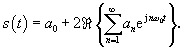
(D.3)

Decomposing a n in magnitude a n and phase ? n by

(D.4)

we obtain from (D.3)

(D.5)

We introduce the real amplitudes

(D.6)
(D.7)

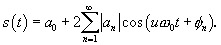
and obtain from (D.3)

(D.8)

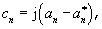
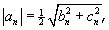
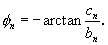
Magnitude a n and phase ? n are obtained from the real amplitudes by b n and c n by

(D.9)
(D.10)

(D.11)

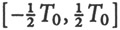
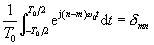
The functions form a complete orthogonal system of basis functions in the interval . Applying

(D.12)

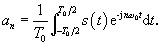
to (D.2) we obtain

(D.13)

It can be shown that arbitrary periodic functions s( t) with period T

UNLIMITED FREE
ACCESS
TO THE WORLD'S BEST IDEAS

SUBMIT
Already a GlobalSpec user? Log in.

This is embarrasing...

An error occurred while processing the form. Please try again in a few minutes.

Customize Your GlobalSpec Experience

Category: IC Electronic Filters
Finish!
Privacy Policy

This is embarrasing...

An error occurred while processing the form. Please try again in a few minutes.