Electromagnetics, Microwave Circuit, and Antenna Design for Communications Engineering, Second Edition

7.10: Circular Cylindric Waveguides

7.10 Circular Cylindric Waveguides

7.10.1 The Circular Waveguide Modes

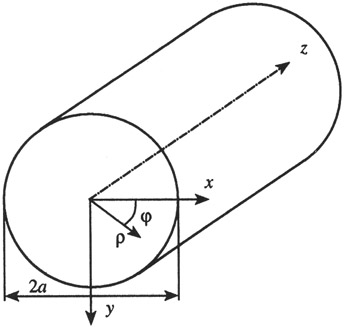
Figure 7.26 shows a circular waveguide with inner diameter 2 a. We investigate the lossless circular waveguide with a perfectly conducting wall and free-space inner region. To investigate the TM and TE modes of the circular cylindric waveguide we derive the fields either from an electric Hertz form ? e or a magnetic Hertz form ? m exhibiting only a z-component

(7.297a)
(7.297b)

Figure 7.26: Circular cylindric waveguide.

For both cases the Helmholtz equation (3.28) has the following form:

(7.298)

with . With (A.157) we obtain for circular cylindric coordinates

(7.299)

We seek solutions for waves propagating in the positive z-direction and choose the separation formulation

(7.300)

From this it follows that

(7.301)

We introduce the parameter k c given by

(7.302)

and obtain

(7.303)

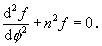
The first two terms of this equation are dependent on r only, whereas the third term only depends on ?. This equation therefore can be fulfilled only if the sum of the first two terms and the last term as well as the third term each are independently constant. Therefore we set the third term equal to - n 2 and obtain

(7.304)

The solution of this equation is

(7.305)

Since f( ?) is periodic with 2 ?, the parameter n must be an integer. Furthermore A' = 0 without loss of generality, since both solutions in (7.305) only are distinguished...

UNLIMITED FREE
ACCESS
TO THE WORLD'S BEST IDEAS

SUBMIT
Already a GlobalSpec user? Log in.

This is embarrasing...

An error occurred while processing the form. Please try again in a few minutes.

Customize Your GlobalSpec Experience

Category: Waveguide Rotary Joints
Finish!
Privacy Policy

This is embarrasing...

An error occurred while processing the form. Please try again in a few minutes.