Electromagnetics, Microwave Circuit, and Antenna Design for Communications Engineering, Second Edition

7.9: Rectangular Waveguides

7.9 Rectangular Waveguides

Figure 7.21 shows a rectangular waveguide (i.e., a waveguide with a rectangular cross-section and the inner dimensions a and b). The waveguide may be empty inside or filled with dielectric material. We first consider the lossless case and assume the waveguide walls to be perfectly conductive and the inner region to be either empty or filled with a homogeneous isotropic lossless dielectric.


Figure 7.21: Waveguide with rectangular cross-section.

7.9.1 Transverse Electric Modes

The electromagnetic field transverse electric (TE) or H modes can be derived from a magnetic Hertz form ? m exhibiting only a longitudinal component ? mz as introduced in (7.8b). In the lossless case the Helmholtz equation (7.9b) is given by

(7.218)

where the phase coefficient ? M 0 is given by

(7.219)

For a wave propagating in the positive z-direction we choose

(7.220)

Furthermore for ? M 0 ( x,y) we choose

(7.221)

and obtain from (7.218), (7.219), and (7.220)

(7.222)

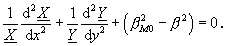
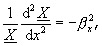
Since the first term in (7.222) depends on x only and the second term on ? only, this equation can be satisfied only if both terms are constant. Therefore the equations

(7.223a)
(7.223b)

must be satisfied and ? x and ? y have to fulfill the condition

(7.224)

The general solutions for X( x) and Y( y) are given by

(7.225a)
(7.225b)

Since we have assumed perfectly conducting waveguide walls, the tangential electric field components must...

UNLIMITED FREE
ACCESS
TO THE WORLD'S BEST IDEAS

SUBMIT
Already a GlobalSpec user? Log in.

This is embarrasing...

An error occurred while processing the form. Please try again in a few minutes.

Customize Your GlobalSpec Experience

Category: RF Waveguide Components
Finish!
Privacy Policy

This is embarrasing...

An error occurred while processing the form. Please try again in a few minutes.