Electromagnetics, Microwave Circuit, and Antenna Design for Communications Engineering, Second Edition
In this chapter we are concerned with the longitudinal variations of the wave amplitudes on a transmission-line. We assume the transmission-line to be excited in a certain mode. The transverse field distribution is determined by the excited mode. In the longitudinal direction the spatial variation of the field is governed by the transmission- line equations (7.57a) and (7.57b). Transmission-line theory is presented in [1 4].
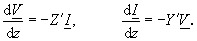
In our treatment of the TEM waveguide we have observed that the transverse field distribution is only determined by the geometry of the waveguide. The state of a transmission-line is described completely by the scalar quantities V( z) and I( z), respectively. Current and voltage are governed by the line equations (7.67) and (7.72). In the same way we can describe the TE 10 mode of a rectangular waveguide by the transmission-line equations (7.273a) and (7.273b), if we are introducing generalized currents and generalized voltages to describe the electromagnetic wave in the waveguide. If we are choosing a certain mode in a waveguide, the specific state of excitation also is given by the generalized voltage and the generalized current, which depend on the longitudinal coordinate z only. We can now formulate the transmission-line equations in a more general form, which is valid for TEM modes in two-conductor waveguides as well as for TE and TM modes,
| (8.1) | |
The characteristic impedance Z 0 is given by
| (8.2) | |
The propagation coefficient ? is...