For a number of coordinate systems the Laplace equation, the Helmholtz equation, and the wave equation may be solved exactly by separation into ordinary differential equations. As the solutions of these ordinary differential equations, special functions occur. In this chapter special functions for circular cylindrical and spherical coordinate systems and some important formulae are summarized. For a detailed presentation of the mathematical background, see for example, [1, 2]. A comprehensive presentation of the coordinate systems for which the partial differential equations mentioned above may be solved exactly, and the methods of solutions are given in [3]. Comprehensive collections of formulae and theorems for the special functions of mathematical physics are provided in [4, 5].
B.1 Ordinary Bessel Functions
The separation of the Helmholtz or wave equation in circular cylindrical coordinates leads to Bessel's differential equation
| (B.1) | 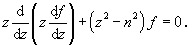
|
The variable z and the parameter n can be arbitrarily complex. However, in the following n will be assumed as real and integer or half-integer. The solutions of Bessel's differential equation are the Bessel function of the first kind J n( z), the Neumann function or Bessel function of the second kind Y n( z), and the Hankel functions of the first kind  and of the second kind
  . The index n denotes the order of the function. The Bessel functions of the first kind J n( z) [1] are defined by
| (B.2) | 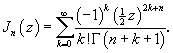
|
For integer n the factorial n
Copyright Artech House, Inc. 2006 under license agreement with Books24x7

 TABLE OF CONTENTS