Epoxy Adhesive Formulations
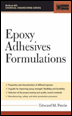
Based on a popular course sponsored by the Society of Plastics Engineers, this comprehensive text presents a variety of methods to ensure optimum epoxy performance and reliability.
 TABLE OF CONTENTS
 Epoxy adhesives are chemical compounds used to join components by providing a bond between two surfaces. Epoxy adhesives were introduced commercially in 1946 and have wide applications in the automotive, industrial, and aerospace markets. Epoxies are probably the most versatile family of adhesives because they bond well to many substrates and can be easily modified to achieve widely varying properties. This modification usually takes the form of
Selection of the appropriate epoxy resin or combination of resins of which many are available
Selection of curing agent and associated reaction mechanism
Simple additions of organic or inorganic fillers and components
Such modification is commonly described as formulating or compounding. Formulating is necessary to achieve an adhesive that will yield the desired application characteristics and end-use properties at an acceptable cost. As a result, an enormous number of epoxy adhesive formulations are possible.
Therefore, it is a mistake to describe epoxy adhesives in a generic manner as if all these formulations had similar properties. Depending on the type of resin and curing agent used and on the specific formulation, epoxy adhesives can offer the user an almost infinite assortment of end properties as well as a wide diversity of application and curing characteristics.
Because of their good wetting characteristics, epoxy adhesives offer a high degree of adhesion to all substrates except for some low-surface-energy, untreated plastics and elastomers. Cured epoxies have thermosetting molecular structures. They exhibit excellent tensile shear strength but poor peel strength unless modified with...