Epoxy Adhesive Formulations
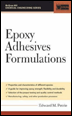
Based on a popular course sponsored by the Society of Plastics Engineers, this comprehensive text presents a variety of methods to ensure optimum epoxy performance and reliability.
 TABLE OF CONTENTS
 A variety of curing agents and catalysts will react with epoxy resins to provide crosslinked adhesives. The curing agents generally react with the available epoxy or hydroxyl groups. The catalysts initiate homopolymerization of the epoxy groups. Six main classifications of curing agents are commonly utilized with epoxy adhesive formulations, and these can be further divided into several subclassifications.
Aliphatic amines and modified aliphatic amines
Polyamides
Aromatic amines and modified aromatic amines
Anhydrides
Catalytic and latent hardeners
Polysulfides and mercaptans
Some curing agents can also be used to form adducts with epoxy resins, and these adducts, in turn, offer unique curing properties with other epoxy resins. Adducts are commonly used in adhesive formulations to reduce the vapor pressure of the system, to modify the reactivity of the system, to improve mix ratios so that they are closer to equal parts of the resin component and of the curing agent component, and to provide a certain degree of flexibility into the end product.
The choice of a particular curing agent or catalyst depends on the processing requirements (e.g., viscosity, pot life, application method, curing temperature, reactivity, mix ratio) and the end-use requirements (e.g., thermal and chemical resistance, shear strength, toughness) of the cured adhesive. The curing agents along with the epoxy resin determine the type of chemical bonds and the degree of crosslinking that will occur.
The advantages, disadvantages, and applications for the major types of epoxy curing agents are summarized in Table 5.1. The required mix ratios, curing temperatures,...