Epoxy Adhesive Formulations
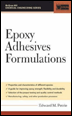
Based on a popular course sponsored by the Society of Plastics Engineers, this comprehensive text presents a variety of methods to ensure optimum epoxy performance and reliability.
 TABLE OF CONTENTS
 Polymerized epoxy adhesives are amorphous and highly crosslinked materials. This micro-structure results in many useful properties such as high modulus and failure strength, low creep, and good chemical and heat resistance. However, the structure of epoxy resins also leads to one undesirable property they are relatively brittle materials. As such, epoxy adhesives tend to have poor resistance to crack initiation and growth, which results in poor impact and peel properties. In sealant formulations, epoxy resins do not often provide the degree of elongation or movement that is required for many applications.
Thus, two qualities are often required for adhesives or sealants that unmodified epoxy resins lack flexibility and toughness. Formulators have overcome these problems by either flexibilizing the epoxy structure or incorporating modifiers into the adhesive. It must be recognized, however, that flexibility and toughness have different meanings in adhesive technology, and flexibilizers and tougheners operate by different mechanisms.
Flexibility is primarily characterized by a material's elongation. Flexibilizers in epoxy systems work by allowing the material to deform under stress. In this way stresses on the joint are distributed over a larger area. The flexibilized epoxy resin has the capability of compensating for differences in thermal expansion or elastic moduli of the substrates.
Flexibilizers improve peel and impact strength generally by allowing the adhesive to deform under the application of stress. Figure 8.1 shows that an adhesive that has greater elongation distributes peel stress over a much larger area than do more rigid adhesives. The adhesive with higher elongation generally...