The Essentials of CAGD

In this first chapter, we cover some basic geometry. We also lay out the notation for the rest of the book. The reader should view this chapter as a reference that covers the prerequisites for the book.
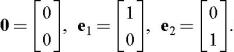
Most geometry that we encounter happens in two or three dimensions. The first step toward formally defining geometry is to define a coordinate system. A coordinate system is defined by its origin 0 (a point) and two (or three) directions e 1, e 2, e 3 (vectors). The system most commonly encountered for a 2D space:
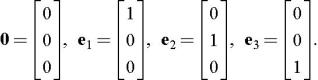
For a 3D space, things are not very different:
The most basic geometric entity is the point, which simply denotes a 2D or 3D location. The collection of all 2D or 3D points is called 2D or 3D affine space or Euclidean space, and is denoted as IE 2 or IE 3. [1] If we pick a particular coordinate system for an affine space, then every point is defined by two or three coordinates. [2]
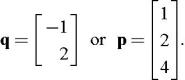
We denote 2D and 3D points by lower case boldface letters, such as q or p. We write point coordinates as columns, for example
If we want to refer to a particular component, we denote it by p x, P y, P z. In our example, we would have p z =...