The Essentials of CAGD

Chapter 4: B zier Curves Cubic and Beyond


Figure 4.1: An excerpt from P. de Casteljau's writings.

B zier curves are not restricted to cubics. Here, we will explore these more general curves.

4.1 B zier Curves

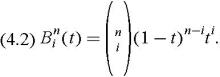
A B zier curve of degree n is defined by


where the B n i(t) are Bernstein polynomials


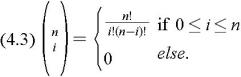
The binomial coefficients are defined as


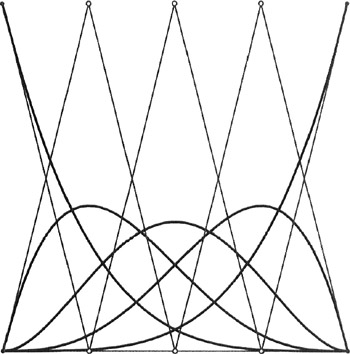
In the cubic case, this is identical to (3.4). The Bernstein polynomials of degree four are shown in Figure 4.2. The control polygons in the figure are explained in a more thorough discussion of Bernstein polynomials in Section 4.9.


Figure 4.2: The Bernstein polynomials of degree four plotted over [0, 1].

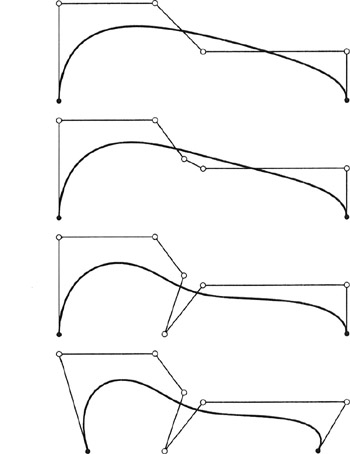
Several examples of higher degree B zier curves are shown in Figure 4.3. These examples show how a user might influence the shape of a B zier curve by adding more control points or moving control points.


Figure 4.3: A sequence of B zier curves.

For general degrees, there are essentially no new properties to report; everything carries over from the cubic case. Be sure to review the properties listed in Section 3.2. Let's revisit the major topics from Chapter 3.

4.2 Derivatives Revisited

For the derivative, we have


where ? b i = b i+1 ? b i. This is again a B zier curve; its degree is n ? 1 and its coefficients are vectors.

B zier curves may be differentiated more than once. The k th derivative at parameter value t is given by


where ? k is the forward difference...

UNLIMITED FREE
ACCESS
TO THE WORLD'S BEST IDEAS

SUBMIT
Already a GlobalSpec user? Log in.

This is embarrasing...

An error occurred while processing the form. Please try again in a few minutes.

Customize Your GlobalSpec Experience

Category: IC Electronic Filters
Finish!
Privacy Policy

This is embarrasing...

An error occurred while processing the form. Please try again in a few minutes.