The Essentials of CAGD

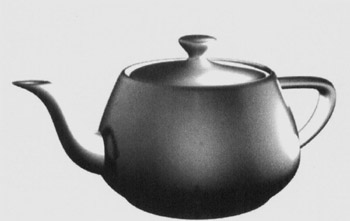
In this chapter, we will encounter surfaces for the first time. We will cover the basic definitions and go on to extend the concept of B zier curves to surfaces. A famous object which is composed of B zier patches is the "Utah teapot," shown in Figure 6.1. [1]
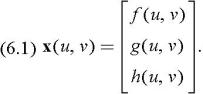
A parametric curve is the result of a mapping of the real line into 2-or 3-space. A parametric surface is defined in a similar way: It is the result of a map of the real plane into 3-space. This "real plane" is called the domain of the surface. It is simply a plane with a coordinate system such that every point has coordinates ( u, v). The corresponding 3D surface point is then a point:
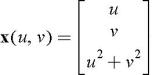
The parametric surface given by
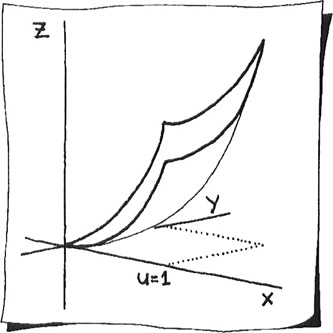
is illustrated in Sketch 39. Of course, only a portion of the surface is illustrated; the surface extends infinitely from each edge. This parametric surface happens to be a functional surface because two of the coordinate functions in (6.1) are simply u and v.
Just as for parametric curves, parametric surfaces may be rotated or moved around they are much more general than bivariate functions of the form z = f( x, y). See the analogous discussion in Section 3.1 for functional curves versus parametric curves.