The Essentials of CAGD

So far, we have described the basic properties of B-spline curves, but we have not not addressed an important question: How does one use them? B-spline curves owe their popularity to the many possible ways in which they can be "put to work." This chapter explores some of those uses.
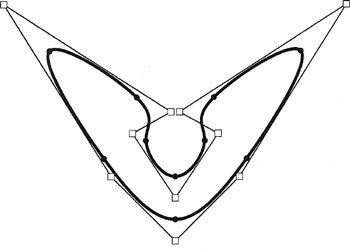
Imagine you want to create a B-spline curve for the character "v" in some fancy font. A first start could be, using closed cubic B-spline curves, to use the control polygon of the bottom of Figure 10.11. Using a mouse or a similar interactive graphic device, you would move individual control points around until the desired shape is accomplished. You might then arrive at a curve which is shown in Figure 11.2.
This manual method is useful for a final fine tuning of a curve shape; for the complete design process, it is too slow. Some of the methods below provide an initial "guess" which, if necessary, may then be modified interactively.
For many applications, many data points are given and a cubic B-spline curve is desired which approximates their shape. The most popular method to find such an approximating curve is that of least squares approximation, much in the spirit of a similar method of Section 5.4.
Suppose we want to approximate a data...