The Essentials of CAGD

10.5: B-Splines: The Building Block

10.5 B-Splines: The Building Block

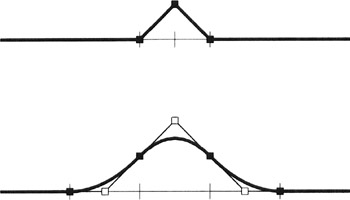
B-splines, the basis functions for B-spline curves as expressed in (10.1), are a generalization of Bernstein polynomials. They are composed of several polynomial pieces, instead of being just one polynomial. These pieces fit together such that the B-spline is of a certain smoothness. Figure 10.6 shows two piecewise polynomials: The top one is piecewise linear and C 0; the lower one is piecewise quadratic and C 1. Recall from Section 9.2, that the continuity class refers to the differentiability at the junction between polynomials; the polynomials themselves are C ?.


Figure 10.6: A piecewise linear and a piecewise quadratic function.

Figure 10.6 shows the B zier points of each polynomial segment; the endpoints of each polynomial are marked by solid squares. [3] A B spline is zero almost everywhere; it assumes nonzero values only for a finite interval. Note how each function vanishes outside a small region; that region is called the function's support. Our piecewise defined functions were "assembled" as B zier curves. For higher degrees, this becomes cumbersome, and a more elegant method is called for. This leads to the theory of B-splines, explained next.

We saw in Section 4.8 how to define a functional B zier curve, i.e., one of the form y = f ( t). Degree n B-spline functions are defined in a similar way. Their control polygons are given by


where ? i = 1/ n ( u i +

UNLIMITED FREE
ACCESS
TO THE WORLD'S BEST IDEAS

SUBMIT
Already a GlobalSpec user? Log in.

This is embarrasing...

An error occurred while processing the form. Please try again in a few minutes.

Customize Your GlobalSpec Experience

Category: Mesh Generators
Finish!
Privacy Policy

This is embarrasing...

An error occurred while processing the form. Please try again in a few minutes.