In this chapter, we will see the main uses of parametric curves: describing geometric shapes using methods such as interpolation and approximation.
5.1 Cubic Interpolation
Suppose you are given four points p 0, p 1, p 2, p 3, and you wish to pass a curve through them, just like the situation shown in Sketch 33. There, the points are 2D, but they might as well be 3D. This is called interpolation.
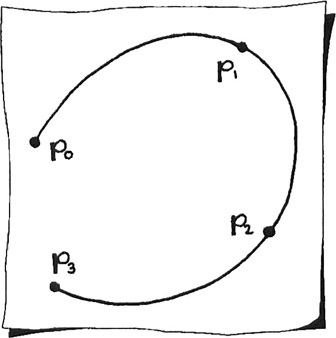 Sketch 33: A cubic B zier curve through four given points.
 We may choose among many kinds of curves; for right now, we'll use a cubic B zier curve. Every point on a B zier curve has a parameter value; in order to solve our problem, we have to assign a parameter value t i to every p i. A natural choice is to associate each p i with a parameter value t i = i/3. Many other suitable choices exist; [1] more on this topic in Section 5.4.
Now our interpolation problem becomes:
Given four point/parameter pairs ( p i, t i), find a cubic B zier curve x( t) such that
This simply states that we want the B zier curve to pass through the data points at the right parameter values.
The desired B zier curve will be of the form
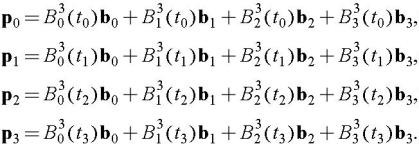
Writing out all interpolation conditions (5.1) yields
These are four equations in the four unknowns b 0, , b 3. In order to...


 TABLE OF CONTENTS