The Essentials of CAGD

By differentiating the N n i in (10.1) and manipulating the indices, we arrive at the first derivative for a B-spline curve:
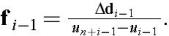
where
The de Boor algorithm provides an easy way to implement this. The two points d n ?1 I ( u) and d n ?1 I+1( u) span the curve's tangent:
This expression is very similar to the first derivative of a B zier curve computed via the de Casteljau algorithm. Notice that derivative vectors must be scaled by the length of the parameter interval. In the discussion of piecewise curves in Section 9.1 this was also the case. If the B-spline curve has multiplicity n at the ends, then the derivatives at the ends take a simple form, see (10.7) and (10.8).
The second derivative:
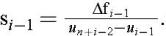
where
The first derivative formula involved knot sequence spans of length n, and the second derivative involves spans of length n ? 1.
The second derivative can also be implemented via the de Boor algorithm. Simply compute the intermediate de Boor points up to d n ?2 i with the normal de Boor algorithm (10.2), and the remaining two steps of the algorithm are modified as follows:
Then the second derivative is
B-spline formulas tend to look quite complicated. To check if a formula is roughly correct, one tip is to try it out for a B-spline that is simply a B zier curve. Let's do just that with...