The Essentials of CAGD

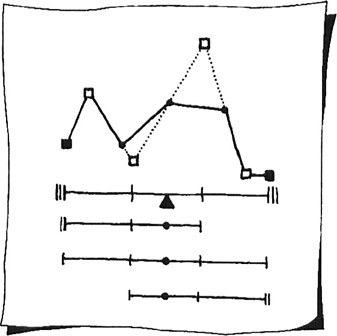
Knot insertion is a tool for adding a knot to a knot sequence, thereby creating a refined control polygon. The trace of the curve with the refined knot sequence is the same as the original curve. An example, which is illustrated by Sketch 94, will best demonstrate.
Let's begin with a function defined by the knot sequence:
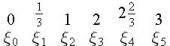
Greville abscissae:
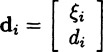
and control ordinates d 0, , d 5. The
are white or black squares in the sketch.
Let's add u = 1.5 to the knot sequence, thus we have the new knot sequence and Greville abscissae:
The refined control polygon for this new knot sequence is
and it is illustrated by a solid-line polygon in Sketch 94. The three new points are circles in the sketch. This process of refinement is also known as corner cutting.
The de Boor algorithm (10.2) is an example of repeated use of knot insertion. Look at the first stage of the algorithm. A parameter u is inserted into the polygon, resulting in a refined polygon. When the knot is inserted n times, we have a point on the curve. However, the de Boor algorithm does not modify the knot sequence or the polygon, leaving it in its original form for the next evaluation. That is why the lengths of the spans decrease at each stage.
A special application of knot insertion is converting...