The Essentials of CAGD

Next, we cover the basics of lines and planes. Linear interpolation is one of the most fundamental operations, both geometrically and computationally. After all, the only arithmetic operations a computer can perform exactly are addition and multiplication the components of linear interpolation. The fundamentals of lines and planes and their various representations are part of this chapter. Finally, the geometric entities, polygons and triangles, are explored.
Two points (assume 2D for now) p and q, define a straight line, or line for short. How can we describe all points on this line?
One way is to imagine a particle, represented by a point x, traversing the line, starting at p at time t = 0, passing through q at time t = 1, and continuing on. We also assume that the speed of our particle is constant. Since the location of x depends on the time t, we also write x( t) instead of just x.
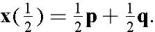
Where is x( t) at any given time t? Since we know x(0) = p and x(1) = q, it seems reasonable to expect
These three instances follow the general pattern
which is the parametric form of a line. This is also called linear interpolation.
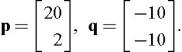
Let
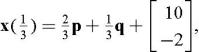
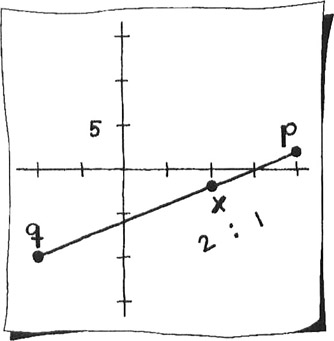
At t = 1/3, we have
which is illustrated in Sketch 12.
Thus, for any real number t,...