Gear Geometry and Applied Theory, Second Edtion

An invaluable reference for designers, theoreticians, students, and manufacturers, this text covers the theory, design, geometry, and manufacture of all types of gears and gear drives.
 TABLE OF CONTENTS
 A position vector in a three-dimensional space (Fig. 1.1.1) may be represented (i) in vector form as

where ( i m , j m , k m) are the unit vectors of coordinate axes, and (ii) by the column matrix
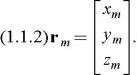

The subscript m indicates that the position vector is represented in coordinate system S m( x m , y m , z m). To save space while designating a vector, we will also represent the position vector by the row matrix,

The superscript T means that  is a transpose matrix with respect to r m.
A point the end of the position vector is determined in Cartesian coordinates with three numbers: x, y, z. Generally, coordinate transformation in matrix operations needs mixed matrix operations where both multiplication and addition of matrices must be used. However, only multiplication of matrices is needed if position vectors are represented with homogeneous coordinates. Application of such coordinates for coordinate transformation in theory of mechanisms has been proposed by Denavit & Hartenberg [1955] and by Litvin [1955]. Homogeneous coordinates of a point in a three-dimensional space are determined by four numbers ( x*, y*, z*, t*) which are not equal to zero simultaneously and of which only three are independent. Assuming that t* ? 0, ordinary coordinates and homogeneous coordinates may be related as follows:

With t