Gear Geometry and Applied Theory, Second Edtion

An invaluable reference for designers, theoreticians, students, and manufacturers, this text covers the theory, design, geometry, and manufacture of all types of gears and gear drives.
 TABLE OF CONTENTS
 The predecessor of involute gearing is the cycloidal gearing that has been broadly used in watch mechanisms. Involute gearing has replaced cycloidal gearing in many areas but not in the watch industry. There are several examples of the application of cycloidal gearing not only in instruments but also in machines that show the strength of positions that are still kept by cycloidal gearing: Root s blower (see Section 13.8), rotors of screw compressors (Fig. 13.1.1), and pumps (Fig. 13.1.2).
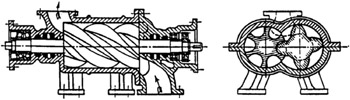
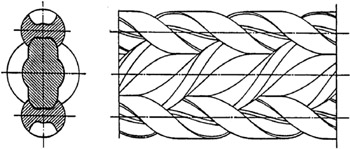
This chapter covers (1) generation and geometry of cycloidal curves, (2) Camus theorem and its application for conjugation of tooth profiles, (3) the geometry and design of pin gearing for external and internal tangency, (4) overcentrode cycloidal gearing with a small difference of numbers of teeth, and (5) the geometry of Root s blower.
A cycloidal curve is generated as the trajectory of a point rigidly connected to the circle that rolls over another circle (over a straight line in a particular case). Henceforth, we differentiate ordinary, extended, and shortened cycloidal curves.
Figure 13.2.1 shows the generation of an extended epicycloid as the trajectory of point M that is rigidly connected to the rolling circle of radius r. In the case when generating point M is a point of the rolling circle, it will generate an ordinary epicycloid, but when M is inside of circle