Gear Geometry and Applied Theory, Second Edtion

An invaluable reference for designers, theoreticians, students, and manufacturers, this text covers the theory, design, geometry, and manufacture of all types of gears and gear drives.
 TABLE OF CONTENTS
 Noncircular gears transform rotation between parallel axes with the prescribed gear ratio function
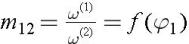
where  is the angle of rotation of the driving gear. The center distance between the axes of rotation is constant. The most typical examples of application of noncircular gears are (i) as the driving mechanism for a linkage to modify the displacement function or the velocity function, and (ii) for the generation of a prescribed function.
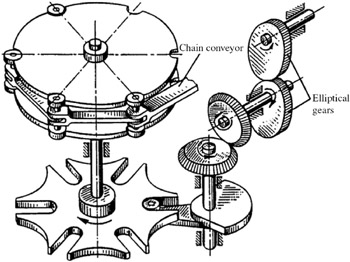
Figure 12.1.1 shows the Geneva mechanism that is driven by elliptical gears. The application of elliptical gears enables it to change the angular velocity of the crank of the mechanism during the crank revolution. A crank slider linkage that is driven by elliptical gears is shown in Fig. 12.1.2. A kinematical sketch of the mechanism is shown in Fig. 12.1.3(a). Application of elliptical gears enables it to modify the velocity function v(  ) of the slider [Fig. 12.1.3(b)]. Oval gears (Fig. 12.1.4) are applied in the Bopp and Reuter meters for the measurement of the discharge of liquid; the oval gears are shown in the figure in three positions. Figure 12.1.5 shows noncircular gears with unclosed centrodes that are applied in instruments for the generation of functions. Figure 12.1.6 shows a noncircular gear of a drive that is able to transform rotation between parallel axes for a cycle that exceeds one gear revolution. During the cycle the gears perform axial translational motions in addition to rotational motions.