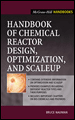
Handbook of Chemical Reactor Design, Optimization, and Scaleup
Chapter 1: ELEMENTARY REACTIONS IN IDEAL REACTORS

Material and energy balances are the heart of chemical engineering. Combine them with chemical kinetics and they are the heart of chemical reaction engineering. Add transport phenomena and you have the intellectual basis for chemical reactor design. This chapter begins the study of chemical reactor design by combining material balances with kinetic expressions for elementary chemical reactions. The resulting equations are then solved for several simple but important types of chemical reactors. More complicated reactions and more complicated reactors are treated in subsequent chapters, but the real core of chemical reactor design is here in Chapter 1. Master it, and the rest will be easy.

1.1 MATERIAL BALANCES

Consider any region of space that has a finite volume and prescribed boundaries that unambiguously separate the region from the rest of the universe. Such a region is called a control volume, and the laws of conservation of mass and energy may be applied to it. We ignore nuclear processes so that there are separate conservation laws for mass and energy. For mass,

(1.1)

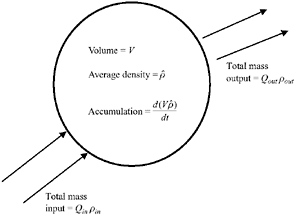
where entering and leaving apply to the flow of material across the boundaries. See Figure 1.1. Equation (1.1) is an overall mass balance that applies to the total mass within the control volume, as measured in kilograms or pounds. It can be written as


FIGURE 1.1: Control volume for total mass balance.
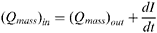
(1.2)

where Q mass is the mass flow rate and I is the mass inventory in the system. We often write...

UNLIMITED FREE
ACCESS
TO THE WORLD'S BEST IDEAS

SUBMIT
Already a GlobalSpec user? Log in.

This is embarrasing...

An error occurred while processing the form. Please try again in a few minutes.

Customize Your GlobalSpec Experience

Category: Process Reactors
Finish!
Privacy Policy

This is embarrasing...

An error occurred while processing the form. Please try again in a few minutes.