Handbook of Chemical Reactor Design, Optimization, and Scaleup
The general material balance of Section 1.1 contains an accumulation term that enables its use for unsteady-state reactors. This term is used to solve steady-state design problems by the method of false transients. We turn now to solving real transients. The great majority of chemical reactors are designed for steady-state operation. However, even steady-state reactors must occasionally start up and shut down. Also, an understanding of process dynamics is necessary to design the control systems needed to handle upsets and to enable operation at steady states that would otherwise be unstable.
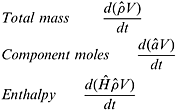
Unsteady mass and energy balances consider three kinds of accumulation:
These accumulation terms are added to the appropriate steady-state balances to convert them to unsteady balances. The circumflexes indicate averages over the volume of the system, e.g.,
The three accumulation terms represent the change in the total mass inventory, the molar inventory of component A, and the heat content of the system. The circumflexes can be dropped for a stirred tank, and this is the most useful application of the theory.
The steady-state balance for total mass is
A well-mixed stirred tank (which we will continue to call a CSTR despite possibly discontinuous flow) has
. The unsteady-state balance for total mass is obtained just by including the accumulation term:
| (14.1) | |
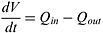
Liquid-phase systems with approximately constant density are common. Thus, the usual simplification of Equation (14.1) is
The component balance for the general case is
| (14.2) | |
The general case treats time-dependent volumes, flow...