Handbook of Chemical Reactor Design, Optimization, and Scaleup

The previous section gave a methodology for calculating V z (r) given ?(r) and ?(r). It will also be true that both ? and ? will be functions of z. This will cause no difficulty provided the changes in the axial direction are slow.
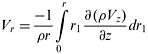
The formulation of Equation (8.68) gives the fully developed velocity profile, V z (r), which corresponds to the local values of ?(r) and ?(r) without regard to upstream or downstream conditions. Changes in V z (r) must be gradual enough that the adjustment from one axial velocity profile to another requires only small velocities in the radial direction. We have assumed V r to be small enough that it does not affect the equation of motion for V z. This does not mean that V r is zero. Instead, it can be calculated from the fluid continuity equation,
| (8.69) | |
which is subject to the symmetry boundary condition that V r(0) = 0. Equation (8.69) can be integrated to give
| (8.70) | |
Radial motion of fluid can have a significant, cumulative effect on the convective diffusion equations even when V r has a negligible effect on the equation of motion for V z. Thus, Equation (8.68) can give an accurate approximation for V z even though Equations (8.12) and (8.52) need to be modified to account for radial convection. The extended versions of these equations...