Handbook of Chemical Reactor Design, Optimization, and Scaleup
The goal of this chapter is to provide semirealistic design and optimization exercises. Design is a creative endeavor that combines elements of art and science. It is hoped that the examples presented here will provide some appreciation of the creative process.
This chapter also introduces several optimization techniques. The emphasis is on robustness and ease of use rather than computational efficiency.
The first consideration in any design and optimization problem is to decide the boundaries of the system. A reactor can rarely be optimized without considering the upstream and downstream processes connected to it. Chapter 6 attempts to integrate the reactor design concepts of Chapters 1 5 with process economics. The goal is an optimized process design that includes the costs of product recovery, in-process recycling, and by-product disposition. The reactions are
| (6.1) | |
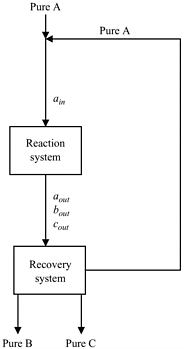
where A is the raw material, B is the desired product, and C is an undesired by-product. The process flow diagram is given in Figure 6.1. For simplicity, the recovery system is assumed to be able to make a clean separation of the three components without material loss.
Note that the production of C is not stoichiometrically determined but that the relative amounts of B and C can be changed by varying the reaction conditions. Had C been stoichiometrically determined, as in the production of byproduct HCl when hydrocarbons are directly chlorinated, there is nothing that can be done short of very...