Handbook of Chemical Reactor Design, Optimization, and Scaleup

Results to this point have been confined to tubular reactors with circular cross sections. Tubes are an extremely practical geometry that is widely used for chemical reactors. Less common is slit flow such as occurs between closely spaced parallel plates, but practical heat exchangers and reactors do exist with this geometry. They are used when especially good mixing is needed within the cross section of the reactor. Using spiral-wound devices or stacked flat plates, it is practical to achieve slit heights as small as 0.003 m. This is far smaller than is feasible using a conventional, multitubular design.
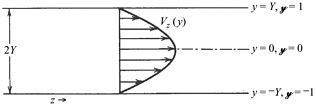
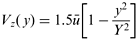
Figure 8.4 illustrates pressure-driven flow between flat plates. The downstream direction is z. The cross-flow direction is y, with y = 0 at the centerline and y = Y at the walls so that the channel height is 2 Y. Suppose the slit width ( x-direction) is very large so that sidewall effects are negligible. The velocity profile for a laminar, Newtonian fluid of constant viscosity is
| (8.37) | |
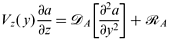
The analog of Equation (8.12) in rectangular coordinates is
| (8.38) | |
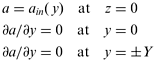
The boundary conditions are
| (8.39) | |
The zero slope boundary condition at y = 0 assumes symmetry with respect to the centerline. The mathematics are then entirely analogous to those for the tubular geometries considered previously. Applying the method of lines gives
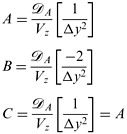
| (3.40) | |
| (8.41) | |
With these revised definitions for A,