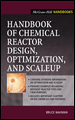
Handbook of Chemical Reactor Design, Optimization, and Scaleup
Chapter 15: RESIDENCE TIME DISTRIBUTIONS

Overview

Reactor design usually begins in the laboratory with a kinetic study. Data are taken in small-scale, specially designed equipment that hopefully (but not inevitably) approximates an ideal, isothermal reactor: batch, perfectly mixed stirred tank, or piston flow. The laboratory data are fit to a kinetic model using the methods of Chapter 7. The kinetic model is then combined with a transport model to give the overall design.

Suppose now that a pilot-plant or full-scale reactor has been built and operated. How can its performance be used to confirm the kinetic and transport models and to improve future designs? Reactor analysis begins with an operating reactor and seeks to understand several interrelated aspects of actual performance: kinetics, flow patterns, mixing, mass transfer, and heat transfer. This chapter is concerned with the analysis of flow and mixing processes and their interactions with kinetics. It uses residence time theory as the major tool for the analysis.

In a batch reactor, all molecules enter and leave together. If the system is isothermal, reaction yields depend only on the elapsed time and on the initial composition. The situation in flow systems is more complicated but not impossibly so. The counterpart of the batch reaction time is the age of a molecule. Aging begins when a molecule enters the reactor and ceases when it leaves. The total time spent within the boundaries of the reactor is known as the exit age, or residence time, t. Except in batch and...

UNLIMITED FREE
ACCESS
TO THE WORLD'S BEST IDEAS

SUBMIT
Already a GlobalSpec user? Log in.

This is embarrasing...

An error occurred while processing the form. Please try again in a few minutes.

Customize Your GlobalSpec Experience

Category: Laboratory Reactors
Finish!
Privacy Policy

This is embarrasing...

An error occurred while processing the form. Please try again in a few minutes.