Handbook of Chemical Reactor Design, Optimization, and Scaleup

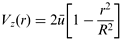
Consider isothermal laminar flow of a Newtonian fluid in a circular tube of radius R, length L, and average fluid velocity ?. when the viscosity is constant, the axial velocity profile is
| (8.1) | |
Most industrial reactors in laminar flow have pronounced temperature and composition variations that change the viscosity and alter the velocity profile from the simple parabolic profile of Equation (8.1). These complications are addressed in Section 8.7. However, even the profile of Equation (8.1) presents a serious complication compared with piston flow. There is a velocity gradient across the tube, with zero velocity at the wall and high velocities near the centerline. Molecules near the center will follow high-velocity streamlines and will undergo relatively little reaction. Those near the tube wall will be on low-velocity streamlines, will remain in the reactor for long times, and will react to near-completion. Thus, a gradient in composition develops across the radius of the tube. Molecular diffusion acts to alleviate this gradient but will not completely eliminate it, particularly in liquid-phase systems with typical diffusivities of 1.0 10 ?9 to 1.0 10 ?10 for small molecules and much lower for polymers.
When diffusion is negligible, the material moving along a streamline is isolated from material moving along other streamlines. The streamline can be treated as if it were a piston flow reactor, and the system as a whole can be regarded as a large number of piston...