Chapter 1 treated single, elementary reactions in ideal reactors. Chapter 2 broadens the kinetics to include multiple and nonelementary reactions. Attention is restricted to batch reactors, but the method for formulating the kinetics of complex reactions will also be used for the flow reactors of Chapters 3 and 4 and for the nonisothermal reactors of Chapter 5.
The most important characteristic of an ideal batch reactor is that the contents are perfectly mixed. Corresponding to this assumption, the component balances are ordinary differential equations. The reactor operates at constant mass between filling and discharge steps that are assumed to be fast compared with reaction half-lives and the batch reaction times. Chapter 1 made the further assumption of constant mass density, so that the working volume of the reactor was constant, but Chapter 2 relaxes this assumption.
2.1 MULTIPLE AND NONELEMENTARY REACTIONS
Multiple reactions involve two or more stoichiometric equations, each with its own rate expression. They are often classified as consecutive as in
| (2.1) | 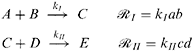
|
or competitive as in
| (2.2) | 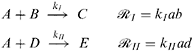
|
or completely independent as in
| (2.3) | 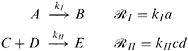
|
Even reversible reactions can be regarded as multiple:
| (2.4) | 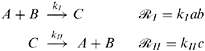
|
Note that the Roman numeral subscripts refer to numbered reactions and have nothing to do with iodine. All these examples have involved elementary reactions. Multiple reactions and apparently single but nonelementary reactions are called complex. Complex reactions, even when apparently single, consist of a number of elementary steps. These steps, some of which may be quite fast, constitute the mechanism
Copyright The McGraw-Hill Companies, Inc. 2002 under license agreement with Books24x7

 TABLE OF CONTENTS