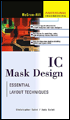
IC Mask Design: Essential Layout Techniques
Chapter 4: Parasitics

Chapter Preview

Here's what you're going to see in this chapter:

  • Parasitic types and causes

  • Parasitic locations

  • Effect of parasitics on a circuit

  • Special high frequency considerations

  • Wiring options

  • Counter-intuitive metal selection

  • Communication examples with your circuit designer

Opening Thoughts on Parasitics

Nothing in an integrated circuit operates perfectly.

An IC is built of layers. You have metals running over other metals. You have transistors next to other transistors. You have transistors built in substrates. Whenever you introduce two different materials like this, you end up creating extra capacitances. It's like we deliberately placed lots of tiny capacitors all over our circuit. And worst of all, we cannot get rid of them.

An IC runs current through wires, implants, and through all sorts of materials. Wherever you expect current to flow you experience the resistance of the material. You end up with unwanted parasitic resistance. This is the same as placing tiny extra resistors in the circuit. And as with parasitic capacitance, you cannot get rid of them.

These and other extra parasitics act as unwanted physical components. They tend to slow your circuit, change the circuit's frequency response or cause a multitude of other nasty things to happen.

When the circuit designers begin their design, they have to take those parasitic components into account. If the parasitic, for instance, is reducing the bandwidth of an amplifier by 10%, then you have to over-design the amplifier to account for the reduction. You incorporate...

UNLIMITED FREE
ACCESS
TO THE WORLD'S BEST IDEAS

SUBMIT
Already a GlobalSpec user? Log in.

This is embarrasing...

An error occurred while processing the form. Please try again in a few minutes.

Customize Your GlobalSpec Experience

Category: Small-Signal Bipolar Transistors (BJT)
Finish!
Privacy Policy

This is embarrasing...

An error occurred while processing the form. Please try again in a few minutes.