Introduction to Simulink with Engineering Applications
2.7: The Mux and Demux Blocks

2.7 The Mux and Demux Blocks

Before describing the Mux and Demux blocks, let us review the functions of a multiplexer (mux) and demultiplexer (demux).

Multiplexing is a method of sending multiple signal streams of information on a carrier at the same time in the form of a single, complex signal and then recovering the separate signals at the receiving end. Analog signals are commonly multiplexed using Frequency Division Multiplexing (FDM), in which the carrier bandwidth is divided into subchannels of different frequency widths, each carrying a signal at the same time in parallel. Cable television is an example of FDM. Digital signals are commonly multiplexed using Time Division Multiplexing (TDM), in which the multiple signals are carried over the same channel in alternating time slots. If the inputs take turns to use the output channel (time division multiplexing) then the output bandwidth need be no greater than the maximum bandwidth of any input. If many inputs may be active simultaneously then the output bandwidth must be at least as great as the total bandwidth of all simultaneously active inputs. In this case the multiplexer is also known as a concentrator.

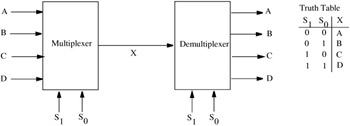
A demultiplexer performs the reverse operation of a multiplexer. Figure 2.5 shows a functional block diagram of a typical 4-line time-division multiplexer/demultiplexer.


Figure 2.15: Mux-Demux pair

In Figure 2.5, A, B, C, and D represent input data to be multiplexed and appear on a single transmission path denoted as X. This path...

UNLIMITED FREE
ACCESS
TO THE WORLD'S BEST IDEAS

SUBMIT
Already a GlobalSpec user? Log in.

This is embarrasing...

An error occurred while processing the form. Please try again in a few minutes.

Customize Your GlobalSpec Experience

Category: Sensor Multiplexers
Finish!
Privacy Policy

This is embarrasing...

An error occurred while processing the form. Please try again in a few minutes.