Introduction to Simulink with Engineering Applications
Chapter 19: Engineering Applications

This chapter is devoted to engineering applications using appropriate Simulink blocks to illustrate the application of the blocks in the libraries which we described in Chapters 2 through 18. Most of these applications may be considered components or subsystems of large systems such as the demos provided by Simulink. Some of these applications describe some of the new blocks added to the latest Simulink revision.

19.1 Analog-to-Digital Conversion

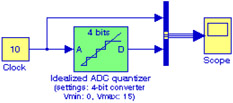
One of the recently added Simulink blocks is the Idealized ADC Quantizer. Figure 19.1 shows how this block can be used to discretize a continuous-time signal such as a clock. The Function Block Parameters dialog box provides a detailed description for this block.


Figure 19.1: Model for Analog-to-Digital conversion

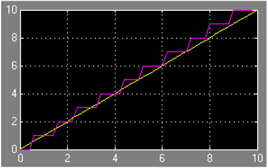
The settings specified for the Idealized ADC Quantizer are noted in Figure 19.1. The output data types for the Clock and the Idealized ADC Quantizer blocks are specified as double. The input and output waveforms are shown in Figure 19.2.


Figure 19.2: Input and output waveforms for the model of Figure 19.1

19.2 The Zero-Order Hold and First-Order Hold as Reconstructors

Suppose that a continuous-time signal x(t) is bandlimited with bandwidth B, and its Fourier transform X( ?) is zero for ? > B. The Sampling Theorem states that if the sampling frequency ? S is equal or greater than 2B, the signal x(t) can be recover entirely from the sampled signal x S(t) by applying x S(t) to an ideal lowpass filter with bandwidth B.

UNLIMITED FREE
ACCESS
TO THE WORLD'S BEST IDEAS

SUBMIT
Already a GlobalSpec user? Log in.

This is embarrasing...

An error occurred while processing the form. Please try again in a few minutes.

Customize Your GlobalSpec Experience

Category: Signal Conditioners
Finish!
Privacy Policy

This is embarrasing...

An error occurred while processing the form. Please try again in a few minutes.