The Laser Guidebook
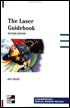
Designed for ease of use and to explain the operation and characteristics of different types of lasers, this book is written to help end-users quickly and easily choose the laser best suited to their needs.
 TABLE OF CONTENTS
 The word laser is an acronym for light amplification by the stimulated emission of radiation, a phrase which covers most, though not all, of the key physical processes inside a laser. Unfortunately, that concise definition may not be very enlightening to the nonspecialist who wants to use a laser, and cares less about its internal physics than its external characteristics. The laser user is in a position analogous to the electronic circuit designer. A general knowledge of laser physics is as helpful to the laser user as a general understanding of semiconductor physics is to the circuit designer. However, their jobs require them to understand the operating characteristics of complete devices, not to assemble lasers or fabricate integrated circuits.
This book is written and organized with the needs of the laser user in mind. The first few chapters describe the basic ideas behind lasers, how they work, and the characteristics that are most important from a user s standpoint. They give an overview of the field, but cannot replace a good textbook or tutorial introduction to lasers. The following chapters focus on individual laser types, first outlining operating principles, then describing specific characteristics such as output power, wavelength, and input power requirements. The Appendix tabulates the most important characteristics of major lasers. The chapters on individual types of lasers follow the same basic outline and are structured both to be read as chapters and to be used for looking up specific data. Inevitably, such a structure brings with...