The Laser Guidebook
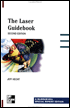
Designed for ease of use and to explain the operation and characteristics of different types of lasers, this book is written to help end-users quickly and easily choose the laser best suited to their needs.
 TABLE OF CONTENTS
 First demonstrated nearly three decades ago (Heard, 1963), the 337-nanometer (nm) molecular nitrogen laser has been available commercially since 1972. One of the first ultraviolet lasers on the market, it was an early pump source for pulsed dye lasers in research laboratories. Excimer lasers and third- and fourth-harmonic output from neodymium lasers can outperform nitrogen, and have pushed it into the background. However, nitrogen lasers remain a viable source of pulsed near-ultraviolet light for a limited range of applications.
Nitrogen lasers offer low-cost, simple operation and short, high-power ultraviolet pulses. Atmospheric pressure nitrogen lasers can produce nanosecond or subnanosecond pulses without the need for complex modelocking schemes. The 337-nm N 2 wavelength is an excellent pump for dye lasers and can generate fluorescence from many materials. On the other hand, nitrogen is inefficient and low in power, with pulse energy limited to about 10 millijoules (mJ) and average power to a few hundred milliwatts in practical designs. Its main uses are for applications which require limited power, or laboratories which cannot afford higher-performance excimer or Nd-YAG lasers.
The active medium in a nitrogen laser is nitrogen gas at pressures between 20 torr [2700 pascals (Pa)] and 1 atmosphere (atm). The gas usually flows through the laser, but sealed nitrogen lasers can operate at low repetition rates. A fast high-voltage discharge populates the upper laser level, an excited electronic state with 40-ns lifetime, which emits at 337.1 nm when it drops to the lower laser level...