The Laser Guidebook
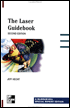
Designed for ease of use and to explain the operation and characteristics of different types of lasers, this book is written to help end-users quickly and easily choose the laser best suited to their needs.
 TABLE OF CONTENTS
 Far more solid-state lasers have been demonstrated experimentally than have ever received any kind of commercial development, let alone reached the market status of those described in Chaps. 22 to 26. Technical reviews (e.g., Weber, 1982) list hundreds of solid-state laser lines produced from dopants in crystalline and glass hosts and in materials where the light-emitting ion is part of the crystalline compound. New solid-state laser systems continue to be developed. The most work has gone into developing hosts for the neodymium ion, but many other active species have been studied in a variety of hosts.
Most of these lasers have never gone much farther than experimental demonstration and initial evaluation. Many suffer from serious inherent weaknesses, including low output power, high laser threshold, requirements for cryogenic cooling, difficult crystal growth, poor material quality, or poor heat dissipation. Others simply offer no compelling advantages over better-developed types. Large investments would be needed to develop the newer materials, and they are hard to justify except for the tunable lasers described in Chap. 24 or other types which offer special advantages.
This chapter covers a few alternative solid-state materials which do offer advantages that have pushed them to the threshold of commercial availability, although none have become standard products. (Vibronic lasers are covered in Chap. 24.) They are based on rare earth ions similar to neodymium: erbium-doped glass emitting at 1.54 micrometers ( ?m) (the same system used in the fiber laser and amplifiers described in Chap. 26); holmium emitting...