The Laser Guidebook
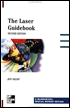
Designed for ease of use and to explain the operation and characteristics of different types of lasers, this book is written to help end-users quickly and easily choose the laser best suited to their needs.
 TABLE OF CONTENTS
 The term laser covers a variety of devices, as will be clear from later chapters. While many lasers bear obvious family resemblances to each other, some types are quite distinct. Helium-neon, ion, and carbon dioxide lasers have some important similarities because they all are electrically excited gas lasers, but at first glance they seem to have little in common with semiconductor diode lasers. However, the operation of all lasers relies on certain common physical principles, and it is those principles that will be covered in this chapter.
Laser physics is a discipline that draws on many other fields, among them quantum mechanics, optics, gas dynamics, semiconductor physics, atomic and molecular physics, and resonator theory. One of the most important factors is the transfer of energy among atoms and molecules, which is closely related to quantum mechanics. Laser characteristics also depend strongly on the optical design of the cavity of the laser medium, and that design, in turn, depends on the physics of the laser medium. This chapter gives an introduction to the fundamentals of lasers; readers seeking a more extensive treatment can consult a number of texts (Milonni and Eberly, 1988; O Shea et al., 1977; Shimoda, 1984; Siegman, 1986; Svelto, 1989; Yariv, 1985).
The formal name for laser physics is quantum electronics. The term dates back to the early days of maser research, and today it is used mainly in connection with academic research. Books with quantum electronics in the title tend toward an emphasis on theory...