The Laser Guidebook
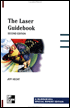
Designed for ease of use and to explain the operation and characteristics of different types of lasers, this book is written to help end-users quickly and easily choose the laser best suited to their needs.
 TABLE OF CONTENTS
 Chemical lasers are those in which a chemical reaction excites an atom or molecule to the upper laser level. J.C.Polanyi proposed the idea at a 1960 conference (Polanyi, 1961), but the first chemical laser did not operate until a few years later (Kasper and Pimentel, 1965). Chemical reactants can store energy quite efficiently and release it quite rapidly in a suitable chamber, so the prime attraction of chemical lasers has long been their potential to generate high powers. Much work in this area has been sponsored by military agencies seeking laser weapons (Hecht, 1984). Most chemical lasers operate on infrared vibrational transitions of diatomic molecules, notably hydrogen halides. Some chemical lasers produce excited atomic states; the most important laser generates excited iodine atoms.
Three types of chemical laser have attracted the most attention: hydrogen fluoride, deuterium fluoride, and iodine. Hydrogen fluoride emits at 2.6 to 3.3 micrometers ( ?m) in the infrared, where atmospheric absorption is strong, and at overtone wavelengths of 1.3 to 1.4 ?m (Jeffers, 1989), where transmission is better. Substitution of deuterium (hydrogen-2) shifts emission to 3.5 to 4.2 ?m, where the atmosphere is more transparent, at the cost of lower efficiency and extra expense for the rare isotope. lodine atoms emit on a 1.3- ?m electronic transition which can be readily pumped by excited molecular oxygen produced by a chemical reaction in a chemical oxygen-iodine laser (Shimizu et al., 1991).
Military researchers have spent hundreds of millions of dollars on building-sized demonstration...