The Laser Guidebook
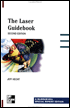
Designed for ease of use and to explain the operation and characteristics of different types of lasers, this book is written to help end-users quickly and easily choose the laser best suited to their needs.
 TABLE OF CONTENTS
 The neodymium laser is the most common member of a family grouped together as solid-state lasers, a term which in the laser world does not encompass semiconductor devices. Qualitatively, neodymium lasers operate much like ruby (the first working lasers) and other solid-state types. Atoms present in impurity-level concentrations roughly 1 percent in a crystalline or glass host material are excited optically by light from an external source, producing a population inversion in a rod of the laser material. The rod is mounted in an optical cavity which provides the optical feedback needed for laser action. The result is a simple and versatile laser which has become a standard tool for diverse applications.
Neodymium lasers are more a family of devices than a single type. The neodymium may be incorporated into various host materials, either single crystals or glasses of different compositions. Accessories can shift the output wavelength from the near-infrared into the visible or ultraviolet. The choice of optical pump source semiconductor laser, pulsed flash lamp, or continuous arc lamp strongly influences laser characteristics. Neodymium lasers can generate continuous beams of a few milliwatts to over a kilowatt, short pulses with peak powers in the gigawatt range, or pulsed beams with average powers in the kilowatt range. Their applications range from esoteric laboratory research to materials working on industrial production lines. No single laser can do all those tasks, but the broad spectrum of commercial products does cover the entire range.
Strictly speaking, the active medium in a neodymium laser is...