The Laser Guidebook
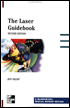
Designed for ease of use and to explain the operation and characteristics of different types of lasers, this book is written to help end-users quickly and easily choose the laser best suited to their needs.
 TABLE OF CONTENTS
 The term excimer laser does not describe a single device, but rather a family of lasers with similar output characteristics. All emit powerful pulses lasting nanoseconds or tens of nanoseconds at wavelengths in or near the ultraviolet. Most commercial excimer lasers can be operated with different gas mixtures to produce different output wavelengths. The technology is relatively new; while commercial devices for scientific applications are fairly well developed, those for medical and industrial applications are still evolving.
The term excimer originated as a contraction of excited dimer, a description of a molecule consisting of two identical atoms which exists only in an excited state; examples include He 2 and Xe 2. It now is used in a broader sense for any diatomic molecule (and sometimes for triatomic types) in which the component atoms are bound in the excited state, but not in the ground state. That property makes them good laser materials with similar output characteristics. The most important excimer molecules are rare gas halides, compounds such as argon fluoride, krypton fluoride, xenon fluoride, and xenon chloride, which do not occur in nature, but which can be produced by passing an electric discharge through a suitable gas mixture. There are also other types of lasing excimers. Many of these molecules are so similar that they can be made to lase in the same device, which has come to be called an excimer laser. This chapter will use the terminology in the broadest commercial sense, even...