The Laser Guidebook
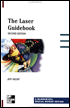
Designed for ease of use and to explain the operation and characteristics of different types of lasers, this book is written to help end-users quickly and easily choose the laser best suited to their needs.
 TABLE OF CONTENTS
 Progress on optical fiber lasers and amplifiers during the last few years has been exceptionally rapid even by laser standards. The fiber laser is in some ways a logical miniaturization of solid-state lasers, and the idea of using an optical fiber as a laser medium is not new. The first fiber amplifier was demonstrated in 1963 using a 1-meter (m) neodymium-doped fiber wrapped around a flashlamp (Koester and Snitzer, 1964). However, the concept received little attention until the mid-1980s, when developers of fiber-optic communication systems began seeking new ways to boost signals to extend transmission distances.
Conventional fiber-optic systems use electro-optic repeaters, which detect a weak optical signal, convert it into electronic form, amplify and process the electronic signal, and use it to drive a laser transmitter. The optical-to-electronic conversion could be avoided by simply passing the weak optical signal through a laser amplifier, to boost its strength. One possibility is the use of semiconductor laser chips coated to suppress facet reflection (described in Chaps. 18 and 20). Another is the use of solid-state fiber laser amplifiers.
The basic concept of a fiber laser amplifier is shown in Fig. 26.1. A fiber is made from a solid-state laser material (typically a glass), doped with an ion which emits at the desired wavelength ? 1. It is illuminated from one end by a weak signal at ? 1 and a stronger steady beam at a second wavelength ? 2 which excites the ion in the fiber...