The Laser Guidebook
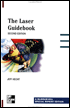
Designed for ease of use and to explain the operation and characteristics of different types of lasers, this book is written to help end-users quickly and easily choose the laser best suited to their needs.
 TABLE OF CONTENTS
 The carbon dioxide laser is one of the most versatile types on the market today. It emits infrared radiation between 9 and 11 micrometers ( ?m), either at a single line selected by the user or on the strongest lines in untuned cavities. It can produce continuous output powers ranging from well under 1 watt (W) for scientific applications to many kilowatts for materials working. It can generate pulses from the nanosecond to millisecond regimes. Custom-made CO 2 lasers have produced continuous beams of hundreds of kilowatts for military laser weapon research (Hecht, 1984) or nanosecond-long pulses of 40 kilojoules (kJ) for research in laser-induced nuclear fusion (Los Alamos National Laboratory, 1982).
This versatility comes from the fact that there are several distinct types of carbon dioxide lasers. While they share the same active medium, they have important differences in internal structure and, more important to the user, in functional characteristics. In theory, the structural variations could range over a nearly continuous spectrum, but manufacturers have settled on a few standard configurations which meet most user needs. Thus users see several distinct types, such as waveguide, low-power sealed-tube, high-power flowing-gas, and pulsed transversely excited CO 2 lasers. This chapter covers all these major types.
The active medium in a CO 2 laser is a mixture of carbon dioxide, nitrogen, and (generally) helium. Each gas plays a distinct role.
Carbon dioxide is the light emitter. The CO 2 molecules are first excited so they...