Machinery's Handbook Pocket Companion

Sine Bar. The sine bar is used either for very accurate angular measurements or for locating work at a given angle as, for example, in surface grinding templets, gages, etc. The sine bar is especially useful in measuring or checking angles when the limit of accuracy is 5 minutes or less. Some bevel protractors are equipped with verniers which read to 5 minutes but the setting depends upon the alignment of graduations whereas a sine bar usually is located by positive contact with precision gage-blocks selected for whatever dimension is required for obtaining a given angle.
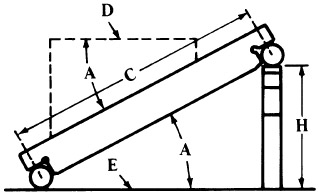
Types of Sine Bars. A sine bar consists of a hardened, ground and lapped steel bar with very accurate cylindrical plugs of equal diameter attached to or near each end. The form illustrated by Fig. 1 has notched ends for receiving the cylindrical plugs so that they are held firmly against both faces of the notch. The standard center-to-center distance C between the plugs is either 5 or 10 inches. The upper and lower sides of sine bars are parallel to the center line of the plugs within very close limits.
The body of the sine bar ordinarily has several through holes to reduce the weight. In the making of the sine bar shown in, if too much material is removed from one locating notch, regrinding the shoulder at the opposite end would make it possible to obtain the correct center distance. That is the reason...