Machinery's Handbook Pocket Companion

Broaching


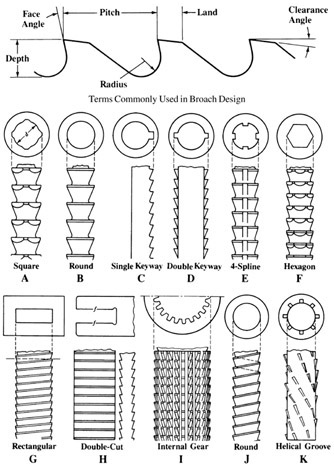
Figure 1: Types of Broaches

Pitch of Broach Teeth. The pitch of broach teeth depends upon the depth of cut or chip thickness, length of cut, the cutting force required and power of the broaching machine. In the pitch formulas which follow

L =

length, in inches, of layer to be removed by broaching

d =

depth of cut per tooth as shown by Table 1 (For internal broaches, d = depth of cut as measured on one side of broach or one-half difference in diameters of successive teeth in case of a round broach)

F =

a factor. (For brittle types of material, F = 3 or 4 for roughing teeth, and 6 for finishing teeth. For ductile types of material, F = 4 to 7 for roughing teeth and 8 for finishing teeth.)

b =

width of inches, of layer to be removed by broaching

P =

pressure required in tons per square inch, of an area equal to depth of cut times width of cut, in inches (Table 2)

T =

usable capacity, in tons, of broaching machine = 70 per cent of maximum tonnage

Table 1: Designing Data for Surface Broaches

Material to be Broached

Depth of Cut per Tooth, Inch

Face Angle or Rake, Degrees

Clearance Angle, Degrees

Roughing [a]

Finishing

Roughing

Finishing

Steel, High Tensile Strength

0.0015 0.002

0.0005

10 12

1.5 3

0.5-1

Steel, Medium Tensile Strength

0.0025 0.005

0.0005

14 18

1.5 3

0.5-1

Cast Steel

0.0025 0.005

0.0005

UNLIMITED FREE
ACCESS
TO THE WORLD'S BEST IDEAS

SUBMIT
Already a GlobalSpec user? Log in.

This is embarrasing...

An error occurred while processing the form. Please try again in a few minutes.

Customize Your GlobalSpec Experience

Category: Broaches
Finish!
Privacy Policy

This is embarrasing...

An error occurred while processing the form. Please try again in a few minutes.