Mastering AutoCAD Civil 3D 2008

Full of advanced techniques and insider tips, this tutorial-based guide will help you understand concepts, create perfect designs, and manage every stage of the project.
 TABLE OF CONTENTS
 The corridor object is a three-dimensional road model that combines the horizontal geometry of an alignment, the vertical geometry of a profile, and the cross-sectional geometry of an assembly.
Corridors range from extremely simple roads to complicated highways and interchanges. This chapter will focus on building several simple corridors that can be used to model and design roads, channels, and trenches.
By the end of this chapter, you'll be able to:
Build a single baseline corridor from an alignment, profile, and assembly
Create a corridor surface
Add an automatic boundary to a corridor surface
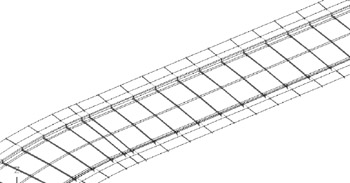
It its simplest form, a corridor is a three-dimensional combination of an alignment, a profile, and an assembly (see Figure 11.1).
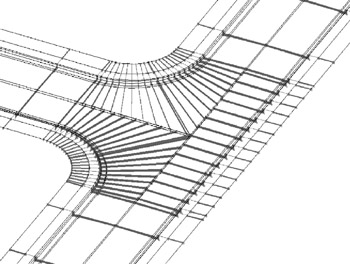
We can also build corridors with additional combinations of alignments, profiles, and assemblies to make complicated intersections, interchanges, and branching streams (see Figure 11.2).
The horizontal properties of the alignment, the vertical properties of the profile, and the cross-sectional properties of the assembly are merged together to form a dynamic model that can be used to build surfaces, sample cross sections, and much more.
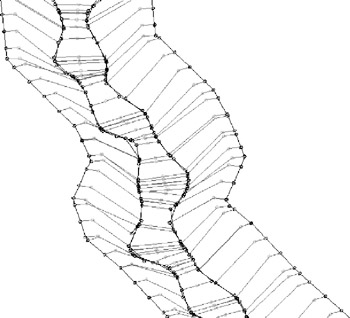
Most commonly, we think of corridors as being used to model roads, but they can also be adapted to model berms, streams, lagoons, trails, and even parking lots (see Figure 11.3).
The first ingredient in any corridor is an alignment.