Operation and Modeling of the MOS Transistor

8.5: NOISE

8.5 NOISE

8.5.1 Introduction

It has so far been assumed that the drain current of a MOS transistor varies with time only if one or more of the terminal voltages vary with time. This is not exactly true. A careful examination of the current reveals minute fluctuations, referred to as noise, which are present whether externally applied signals are present or not. Such fluctuations can occur due to several mechanisms (see below). Noise can interfere with weak signals when the transistor is part of an analog circuit, [103], [104], [105] so ways to predict and possibly reduce noise are very important. For this reason, the subject of noise in MOS transistors has received extensive treatment in the literature. This section is devoted to this subject. We have chosen to treat noise as part of our discussion of small-signal modeling, because noise is, in a sense, an internally generated small signal in the device, and can be modeled with appropriate additions to the small-signal equivalent circuits we have already developed in this chapter.

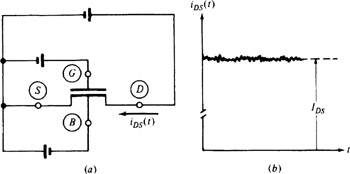
Consider a transistor with dc bias voltages, as shown in Fig. 8.31a. The total drain current, shown in Fig. 8.31b, can be expressed as


Figure 8.31: ( a) A MOS transistor biased with fixed noiseless terminal voltages; ( b) the drain-to-source current for the connection in ( a), including noise.

where I DS is the ideal (bias) current and i n( t) is the noise component, which has...

UNLIMITED FREE
ACCESS
TO THE WORLD'S BEST IDEAS

SUBMIT
Already a GlobalSpec user? Log in.

This is embarrasing...

An error occurred while processing the form. Please try again in a few minutes.

Customize Your GlobalSpec Experience

Category: Transistors
Finish!
Privacy Policy

This is embarrasing...

An error occurred while processing the form. Please try again in a few minutes.