OVERVIEW
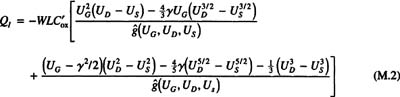
Using the charges per unit area as they correspond to the complete strong-inversion model of Sec. 4.5.1 [(4.5.9) and (4.5.10)], and proceeding as in Sec. 7.4.2, we obtain for the nonsaturation region [1]
with
where
In saturation, of course, V DB should be replaced by V P as given by (4.5.11).
The above expressions have the problem that the numerator and denominator become zero as U D ? U S goes to zero. This problem can be bypassed if one factors out the quantity U 1/2 D ? U 1/2 S from numerator and denominator. [1]
Sometimes simpler, empirical expressions are used in conjunction with this model. In choosing such expressions, one should seek to preserve the symmetry inherent in the model. Also, the expressions should be such that charge saturation is attained at the same voltage combinations as drain current saturation. For example, an empirical expression for Q I in nonsaturation that satisfies these requirements is [2]
where
and
By using two different thresholds as corresponding to the source and drain biases, total symmetry is ensured for Q I with respect to V S and V D. In saturation at the drain, Q I can be obtained by using V GD = V T( V DB), i.e., V 2 = 0; it is easy to see that this results in (7.4.27).
The Q D and Q S expressions resulting from exact calculations for...


 TABLE OF CONTENTS