Optical System Design
Taking the math and the mystery out of optical design, this comprehensive book uses a graphics-oriented approach, making optical design techniques easy to understand through hundreds of detailed diagrams.
 TABLE OF CONTENTS
 In an optical system, there are apertures which are usually circular that limit the bundles of rays which go through the optical system. In Fig. 2.1 a classical three-element form of lens known as a Cooke triplet is shown as an example. Take the time to compare the exaggerated layout (Figs. 2.1a and b) with an actual computer optimized design (Fig. 2.1c). From each point in the object only a given group or bundle of rays will go through the optical system. The chief ray, or principal ray, is the central ray in this bundle of rays. The aperture stop is the surface in the system where all of the chief rays from different points in the object cross the optical axis and appear to pivot about. There is usually an iris or a fixed mechanical diaphragm or aperture in the lens at this location. If your lens has an adjustable iris at the stop, its primary purpose is to change the brightness of the image. The chief ray is, for the most part, a mathematical convenience; however, there definitely is a degree of symmetry that makes its use valuable. We generally refer to the specific height of the chief ray on the image as the image height.
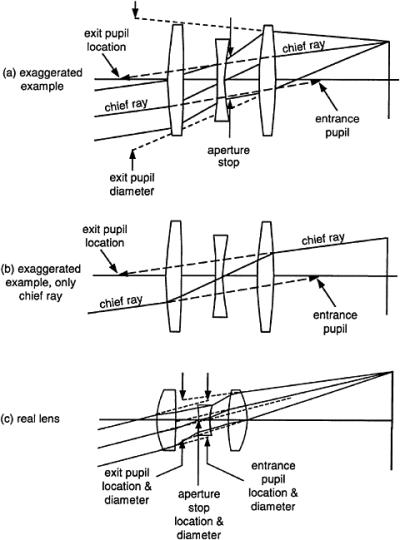
The entrance pupil is the image of the aperture stop when viewed from the front of the lens,...