Optical System Design

Taking the math and the mystery out of optical design, this comprehensive book uses a graphics-oriented approach, making optical design techniques easy to understand through hundreds of detailed diagrams.
 TABLE OF CONTENTS
 To illustrate how lens designs for the thermal infrared look and work, we show in Figs. 12.24 through 12.31 designs for an f/2 LWIR lens 25 mm in diameter covering a field of view of 2.5 . The materials include germanium, AMTIR 1, zinc sulfide, and zinc selenide. We show for each design a layout, the transverse ray aberration curves on axis and at 2.5 off axis. Also tabulated is the design prescription data along with the rms wavefront error, which is the average of the axis, 1.25 off axis and 2.5 off axis. With these data you can set up these designs and work with them as you wish. Do note that there is no consideration given to cold stop efficiency in these examples.
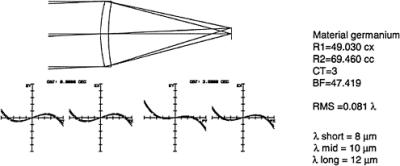
The resulting performance is shown in Table 12.3.
| Lens Construction | RMS Wavefront Error | Diffraction Limited |
|---|---|---|
| Germanium singlet | 0.08 | Nearly |
| AMTIR 1 singlet | 0.20 | No |
| Zinc sulfide singlet | 0.85 | No |
| Zinc selenide singlet | 0.35 | No |
| Germanium/zinc sulfide doublet | 0.047 | Yes |
| Germanium/AMTIR 1 doublet | 0.051 | Yes |
| AMTIR 1/zinc sulfide doublet | 0.053 | Yes |
| Zinc selenide/zinc sulfide | 0.057 | Yes |
In Fig. 12.32 we show an f/3 lens with 100% cold stop efficiency along with its design data. Note that this design form is different from that shown in Fig. 12.4 where we achieved 100% cold stop efficiency by reimaging the first element, which also was the aperture...