Optical System Design

Taking the math and the mystery out of optical design, this comprehensive book uses a graphics-oriented approach, making optical design techniques easy to understand through hundreds of detailed diagrams.
 TABLE OF CONTENTS
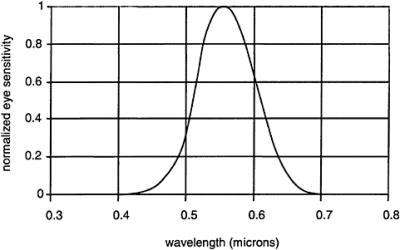
 Every optical system works in its own particular wavelength region determined by the spectral characteristics of the light source, the spectral sensitivity of the sensor, as well as any other factors or components which alter the net sensitivity of the system. If an optical system is a visual system, the optical materials must be transmissive between approximately 425 and 675 nm, as determined by the photopic spectral response curve of the human eye. The photopic eye sensitivity is shown in Fig. 6.1. Optical glasses are the most commonly used materials in optical systems. However, there are some optical plastics with good transmission in the visible spectrum that can be injection molded. In high-volume production, this technology is significantly cheaper than classical glass manufacturing methods. Operating temperature range is very important when choosing optical materials. Optical materials change their index of refraction with temperature, and they also expand differently, changing the lens shape and optical power. Optical plastics have approximately one order of magnitude higher coefficient of thermal expansion than glasses.
If the temperature in an optical system rises to a few hundred degrees Celsius, plastic materials cannot be used because the plastic will melt. Most optical glasses can withstand temperatures of a few hundred degrees Celsius without changing their shape. In illumination systems close to the light source, the temperature can go up to 900 C. In this case, glass optics will melt too. Fused quartz or fused silica...