Optical System Design
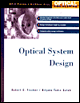
Taking the math and the mystery out of optical design, this comprehensive book uses a graphics-oriented approach, making optical design techniques easy to understand through hundreds of detailed diagrams.
 TABLE OF CONTENTS
 In this chapter we will guide you through several representative design studies and parametric analyses in order to demonstrate the design process. We will begin with the design, from basic principles, of an achromatic doublet. Included will be the detailed computer input and output using the Zemax software package, one of the industry's standards. Following a successful design effort on the doublet, we will show the design of a low f/number double Gauss lens similar to a high-quality 35-mm camera lens. And then we will work through a case study for a digital camera lens. Following this, we will show the design for a 7 50 binocular. And, finally, we will show a parametric analysis of single-element and achromatic doublets using various manufacturing technologies, including aspherics, diffractive surfaces, and others.
Prior to embarking on several design examples, we need to discuss how the measure of performance, or the error function, is computed in a lens design program. Since this error function must be computed a very large number of times during the optimization process, it must be kept as simple as possible so it computes quickly. The construction of an error function was discussed in Chap. 9.
We could use the third-, fifth-, and seventh-order aberrations for our error function. These are very fast to compute; however, with today's complex systems, these aberrations rarely represent sufficiently well the real performance. We could alternatively combine these third-, fifth-, and seventh-order aberrations with specific ray aberrations...