Optical System Design
Taking the math and the mystery out of optical design, this comprehensive book uses a graphics-oriented approach, making optical design techniques easy to understand through hundreds of detailed diagrams.
 TABLE OF CONTENTS
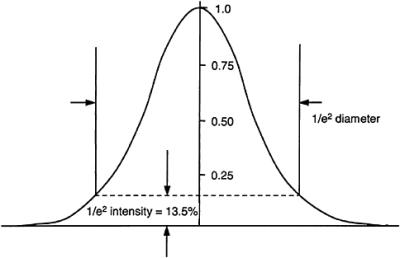
 Coherent light generated by lasers has properties different from light generated by other sources which we usually deal with in more conventional optical systems. If we look through a telescope at a distant object, the light intensity across the entrance pupil and aperture stop is uniform, and this is generally known as a "top-hat" intensity profile or distribution. A telescope objective, if it is free of aberrations, focuses a point object into an Airy disk pattern, with the diameter determined by the f/number or numerical aperture of the objective lens. In this case, a uniform top-hat distribution in pupil space transforms mathematically (by the optical system) to an Airy disk in image space. Laser beams emitted from rotationally symmetric resonators, such as HeNe or YAG lasers with a TEM00 output, have an intensity distribution across the beam which is in the form of a gaussian intensity profile, as shown in Fig. 11.1. A gaussian intensity distribution in pupil space will mathematically transform to a gaussian in image space if the beam is not truncated by the aperture of the optical system, which is, of course, different from the uniform pupil transformation. Note that all of the material in this chapter assumes an aberration-free optical system. It is important to include the effects of lens aberrations in the final assessment of image quality and spot size.
The optical design of systems through which laser beams propagate is, therefore, very different from the design of...